20 October 2006 - January 21, 2007
Bricherasio building houses for the first time in Italy, the Foundation's collection Jean and Suzanne Planque: The exhibition, curated by Florian Rodari, about 100-130 showcases paintings and drawings of the greatest artists of the first half of the twentieth century. The collection, along with extraordinary coherence and heterogeneity of the works, patiently collected over fifty years of life, expressed in full the outstanding quality of the eye of Jean Planque and pays tribute to the various nuances of his sensibility. Extraordinary collection of masterpieces, this collection is worthy of great attention to the caution of the choices made by the collector and for the rare delicacy of certain works. The public will have the opportunity to admire the work of the most important Masters of Modern Art (by Cézanne, Picasso, Degas, Bonnard, Van Gogh, Rouault, Dubuffet, Klee), which provided will appreciate the effectiveness and depth of the pictorial language, comparing it with the new search expression, which breaking with the academic nature imposed by tradition, will open its doors to the experimentalism that characterized the entire production of figurative successivi.Nel years during his systematic survey of the most prestigious exhibitions in galleries in Switzerland and Paris in search of masterpieces to be purchased for Beyeler Gallery, Planque was able to give us a few more paintings and drawings by impressionists such as Gauguin, Van Gogh, Degas, Monet and Renoir. The special relationship with the city of Paris, which has attracted the art, gives body to a substantial collection of works by French artists, Braque, Dufy, Léger by Delaunay. Finally, the collection boasts two prestigious collections of works by Picasso and Dubuffet, Jean Planque great friends. Having "the most beloved paintings that life is a kind of policy statement which Planque justifies his irrational and passionate approach to art. That same energy and enthusiasm that the ransom cultural arm of someone who has "done everything myself, from scratch, without culture, without economic means." A fabulous destiny that has allowed him to become, thanks encounter with the great art dealer Ernst Beyeler in Basel, connoisseur of fine works of great masters of the avant garde movement, but also to meet and become friends with many artists. His, however, is not intended only as a merchant's career, but his fate is also a collector's animated by the desire to acquire, preserve and protect as many of the most beloved works of artists of the time, and avoid that the spiritual dimension of art is too contaminated by the material more of a market economy. The total dedication to a single passion, the knowledge of having given up a bright future to follow the irrational impulse him to knock on the door of the tunnels, to buy his first canvases, to converse with the most representative artists of his generation, does nothing but increase the charm of melancholy and singular figure in some ways exceptional Jean Planque. Specifically
-Picasso Dubuffet ...
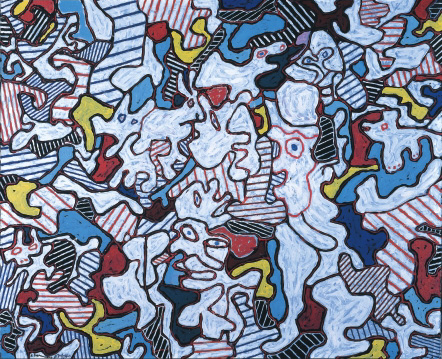
Two groups of works, curiously symmetrical stand out on the rest of the collection Jean Planque. Picasso and Dubuffet are each represented by about thirty pieces, spread in time - 1917 to 1970 with regard to Picasso, from 1949 to 1984 to Dubuffet. Formed from the forties, and especially the beginning of his collaboration with Beyeler in 1954, the collection Planque continued to enrich themselves even after the end of this association, in 1972, for example with the acquisition of Psychos, Mire and a Non-lieu of the last years of Dubuffet. How judge's insistence that look parallel on these two great artists? Opposites in everything you say if, on closer inspection, turn out to be, with the help of the notes and memories of Jean Planque, secretly woven dialogue, relations are not immediately visible that united the two workshops, through 's lover who was allowed into the unit (sometimes) as in the (very often). His relationship with Dubuffet, who knows and who contributes to "discover" in the middle the fifties and which soon will establish a deep bond of friendship is different, however, from the beginning, from the Picasso, which gives (after 1960) to its utmost sincerity the rare privilege of a few long talks in his studio , in front of his works. In both cases, immediately shoot the spring of the fascination of involvement.
the next ... ;)


0 comments:
Post a Comment